ABSTRACT This paper describes how automatic behavior can drive disparities in youth outcomes like delinquency and dropout. We suggest that people often respond to situations without conscious deliberation. While generally adaptive, these automatic responses are sometimes deployed in situations where they are ill-suited. Although this is equally true for all youths, disadvantaged youths face greater situational variability. This increases the likelihood that automaticity will lead to negative outcomes. This hypothesis suggests that interventions that reduce automaticity can lead to positive outcomes for disadvantaged youths. We test this hypothesis by presenting the results of three large-scale randomized controlled trials (RCTs) of interventions carried out on the south and west sides of Chicago that seek to improve the outcomes of low-income youth by teaching them to be less automatic. Two of our RCTs test a program called Becoming a Man (BAM) developed by Chicago-area non-profit Youth Guidance; the first, carried out in 2009-10, shows participation improved schooling outcomes and reduced violent-crime arrests by 44%, while the second RCT in 2013-14 showed participation reduced overall arrests by 31%. The third RCT was carried out in the Cook County Juvenile Temporary Detention Center (JTDC) in 2009- 11 and shows reductions in return rates of 21%. We also present results from various survey measures suggesting the results do not appear to be due to changes in mechanisms like emotional intelligence or self-control. On the other hand results from some decision-making exercises we carried out seem to support reduced automaticity as a key mechanism. Continue reading
Author Archives: Sean Leaver
Behavioural economics and the complexity of school choice
This is the abstract for a seminar I presented to the Victorian Dept. of Education and Training on the 13th April 2015 on behavioural economics and the complexity of school choice.
ABSTRACT The purpose of this seminar is to present research investigating the decision architecture of how parents choose a school for their children through the lens of behavioural economics. The research focuses on providing insights into the following key questions : To what extent does active choice exist and is there choice inertia? What are the decision rules parents use to overcome complexity and limited opportunities for learning? What are the choice attributes that motivate a parent’s choice of school? Do parent behave differently when making educational choices for their children compared to other economic decisions? And is there a relationship between the behavioural components of the decision making and the type of school chosen? The talk will also focus on how behavioural economics can inform research design. Using exploratory interviews of parents to observe economic decision making in the field. Relating these observations back to economic theory to generate possible explanations for choice behaviour. And then subsequently testing these hypotheses by going back into the field and collecting quantitative evidence. Both the implications of my results and the general application of behavioural economics to education policy will be discussed.
Call for unis to carry HECS loans risk
I was interviewed yesterday on my submission to the Australian Senate inquiry into higher education deregulation.
“Vice chancellors are being disingenuous at the moment. They are freeloading and are comfortable with the government taking all the risk. They need to get out of the sandpit and into the real world,”
The attached pdf is a copy of the resulting article in The Australian today.
An Incentive Compatible Model for Higher Education deregulation
On Friday I made a submission to the Senate Inquiry into “The principles of the Higher Education and Research Reform Bill 2014, and related matters”. The submission was accepted and now available for public release (attached).
In summary: “The purpose of this submission is to suggest a model which combines the social equity benefits of Income-contingent Loans with a market design that is ‘incentive compatible’ through an appropriate price discovery mechanism.”
The model seeks to ensure ‘incentive compatibility’ between the social objectives of Income-Contingent Loans and market objectives of returns to investments in education being optimised. Continue reading
Research Plan – papers to be written based on Survey Results
Papers I’m preparing based on results from the School Choice survey
1. Six rules parent’s use to solve the problem of complexity and uncertainty in school choice
2. Extent to which children participate in school choice
3. Complexity of school choice, joint decision making and the potential for conflict
4. Quantity and Quality of Children: Why parent education trumps wealth
5. Intergenerational stickiness of school choice: An Australian perspective
6. The Alchian-Allen effect in school choice: School travel time and a child’s ability
7. To what extent does active school choice exist in Australia?
8. Determinants of school choice: What motivates parents to choose a particular school?
9. Big-5 personality traits and a parent’s choice of school
10. The value of Field Economics: An exploration of school choice in Australia
11. Hardest decision parents will make: School Choice
12. Social Preferences of Australian Parents & School Choice
Plus I need to submit the following paper soon:
1. Behavioural education economics
Why research reputation trumps teaching reputation in universities
Submitted to the Journal for Brief Ideas
Why research reputation trumps teaching reputation in universities
In humans we see lekking behaviour in the general rule that people like being around successful people. This is why social A-lists exist. More generally as animal behaviour, a lek is a gathering of individuals for the purposes of competitive display – competitive signalling. For universities, A-list researchers attract other high quality researchers and also crucially high quality teachers. Why is this important for attracting high quality teachers? Academics themselves are generally seen to be sensitive to reputational influences of their peer group. High quality teachers will be hesitant to join to a university who’s reputation is ambiguous (uncertainty as to rank). The solution is to have an unambiguous reputational signal. However, the signal needs to overcome the problems of asymmetric information associated with the observation (‘measurement’) of quality. It is for this reason that research reputation trumps teaching reputation. Research reputation is a less ambiguous signal as a result of the strength of external validation – active peer review in both academic and public domains (media). Teaching reputation is harder to validate outside the university in which it occurs, leading to the problem of asymmetric information.
Leaver S 2015 ‘Why research reputation trumps teaching reputation in universities’ Journal for Brief Ideas, Zenodo,10.5281/zenodo.15414
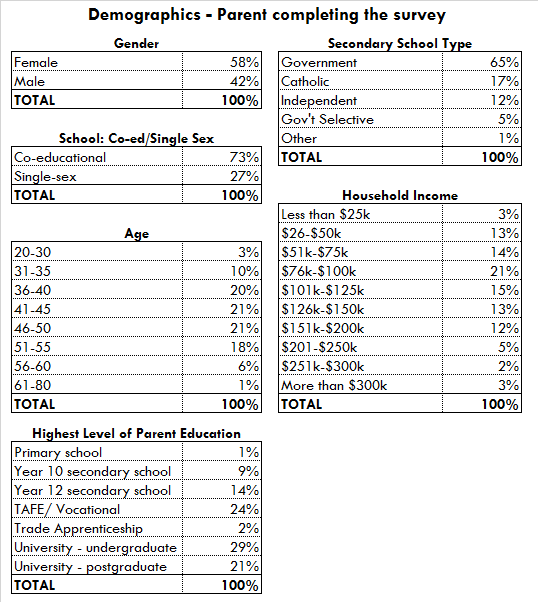
Survey demographics – School Choice
The surveys generated a representative spread of parent backgrounds, including age, education level and household income.
The survey also generated a good spread of secondary school types attended by children. A situation where children in one family attend more than one school type (Mixed) is likely to occur because of 1) individual children gaining selective entry or Continue reading
‘Determinants of Parent School Choice’ Online Survey – the Results
This post will provide updated links to results as I post them. Posts will initially focus on straight forward results associated with specific questions, before proceeding onto more complex statistically analysis of relationships between questions. Continue reading
‘Determinants of Parent School Choice’ Online Survey
I’m a PhD student at RMIT investigating the underlying motivations of parent school choice from an economics perspective. The objective of this research is to understand the behavioural decision rules used by parents in choosing schools for their children. This survey is anonymous and may take up to 30 mins to complete. A brief bio about myself can be found here.
——————————————– The survey is now closed —————————–
The key focus of this survey is the idea that education is an investment in a child’s future. Consequently, investments in a child’s education (such as school choice) are generally considered to be governed by the same general economic principles that we see in similarly complex decision making. However, parents usually make these decisions with limited time and resources. This survey seeks to test this assumption by understanding the relationship between school choices and economic behaviour linked to risk and social preferences. We draw on insights from behavioural economics to test whether decision behaviour is consistent across different types of choices and different contexts in which choices are made. This survey follows on from my qualitative research into school choice (Victoria, Australia). It also draws on some interesting observations coming out of the linguistic analysis of these qualitative interviews which indicated the potential existence of distinct economic decision types influenced by economic risk and social preferences. The survey also draws inspiration from Jonathon’s Haidt’s research on how ‘Liberals and conservatives rely on different sets of moral foundations’. The other investigators for this research project are my PhD supervisors Professor Jason Potts, Dr Foula Kopanidis from RMIT’s School of Economics, Finance & Marketing and the research has been approved by RMIT’s Human Research Ethics committee (No.18945).
Native Australian Purple Bearded Orchid
Submission to Senate Inquiry into Higher Education and Research Reform Amendment Bill 2014
Attached is my submission to the Australian Senate Inquiry into the Higher Education and Research Reform Amendment Bill 2014
PDF: Higher Education and Research Reform Amendment Bill 2014 – Sean Leaver
Senate Inquiry page: Higher Education and Research Reform Amendment Bill 2014
Deregulation of university fees will leave the disadvantaged at greater debt risk
My article published in The Australian newspaper today:
Deregulation of university fees will leave the disadvantaged at greater debt risk
IF there is one thing we should have learned from the global financial crisis, it is that free markets, deregulation and government-subsidised debt ultimately end up creating financial bubbles.
What motivates parents to choose a particular school?
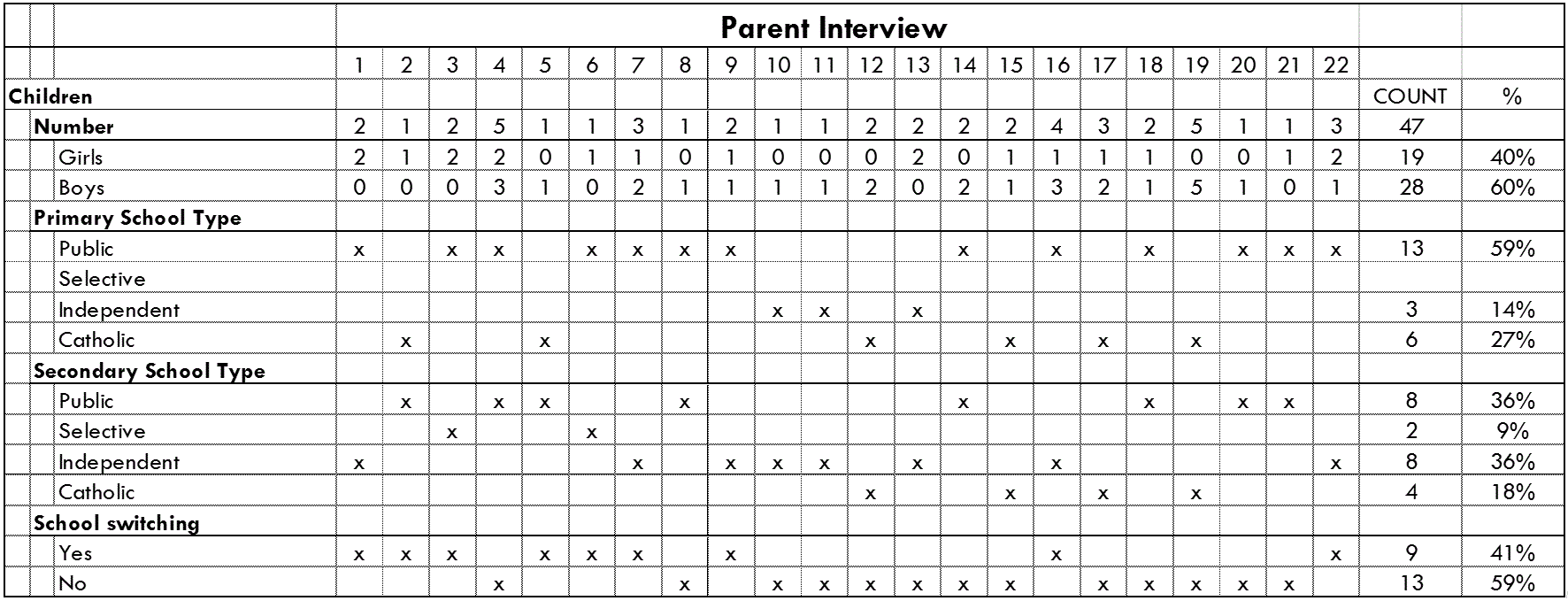
To answer this question, 22 parents from Melbourne and regional Victoria, Australia, were interviewed. These parents came from a broad range of middle socio-economic backgrounds. Parents were sourced through school newsletters or advertisements in local community newspapers. The diversity of this group of parents is provided in the table below.
Table 1.Demographics of parents interviewed.
Parents where asked open questions at the beginning of each interview about their children’s education and the school which they attend. A set of specific questions were then asked about when they started to decide on a school, what they thought were positive and negative characteristics of a school, the importance of teaching and academic performance, the culture of the school, and proximity of the school. Questions were also asked to understand how the parents arrived at a joint decision, whether their children participated in the decision making, and how they went about collecting information in order to choose or evaluate a school.
One part of the interview analysis involved tabulating a list of preferences parents indicated as reasons for choosing, or not choosing, a particular school. Each interview was then evaluated to generate a list of preferences that were salient for each parent in their school choice decision.
Universities as an economic ‘club good’ – the importance of research and why some institutions fail
Universities are characterised, compared with other tertiary education providers, as having a significant amount of resources dedicated to research activities. Typically, an elite university will direct 40-50% of its academic resources towards research. This is despite the fact that university research is cash-flow negative even after all government grants and commercial revenue are taken into account. As a rule, an optimistic expectation would be that for every two dollars spent on research you may get one dollar back as either grants or revenue. Typically, it is closer to 3:1. The financial viability of universities rests on its ability to generate teaching revenue. Teaching undergraduates and postgraduate coursework students. Curiously, a strong link between the university research undertaken and the courses being taught is not necessary to ensure strong student enrolments and financial viability. The reason for this is the key role research plays in generating strong reputational benefits for the university.
Experimental evidence of ‘Intergenerational Egalitarianism’ – Hauser et al 2014: Cooperating with the future
ABSTRACT: Overexploitation of renewable resources today has a high cost on the welfare of future generations. Unlike in other public goods games, however, future generations cannot reciprocate actions made today. What mechanisms can maintain cooperation with the future? To answer this question, we devise a new experimental paradigm, the ‘Intergenerational Goods Game’. A line-up of successive groups (generations) can each either extract a resource to exhaustion or leave something for the next group. Exhausting the resource maximizes the payoff for the present generation, but leaves all future generations empty-handed. Here we show that the resource is almost always destroyed if extraction decisions are made individually. This failure to cooperate with the future is driven primarily by a minority of individuals who extract far more than what is sustainable. In contrast, when extractions are democratically decided by vote, the resource is consistently sustained. Voting is effective for two reasons. First, it allows a majority of cooperators to restrain defectors. Second, it reassures conditional cooperators that their efforts are not futile. Voting, however, only promotes sustainability if it is binding for all involved. Our results have implications for policy interventions designed to sustain intergenerational public goods.
The key insight of this experiment is that a system based on simple democratic rules can overcome the tendency of small groups of people to rationally over exploit resources in the current generation leading to resource collapse. Given that there will always be some probability that there will be individuals who rationally have no regard for future generations, resource collapse is (almost) certain to occur. However, the authors show that simple democratic voting rules binding all participants are effective in restraining this rational, generationally selfish, behaviour. Consequently, resources are sustained over multiple generations of participants.
This paper dove-tails with a two of key areas related to intergenerational investment & the role of government.
Results from school choice interviews – Switching schools
Switching school type – primary to secondary school
Of the 22 parents interviewed, nine families (41%) changed the type of school their children attended between primary and secondary school. Most of these changes, five families, were from public schools to independent schools. Two families enrolled their children in selective public schools and two families made the decision to change from a Catholic primary school to a public secondary schools. The change from Catholic public primary schools to public secondary schools was largely motivated by strong preferences for a co-education school environment. Catholic secondary tend to be predominantly single sex schools.
Switching schools – parents’ and children’s secondary school attended
In general choices followed the academic background of the parents. Choices where changed either when parent schooling experience was negative or a salience characteristic of the parent school experience was missing. For example, negative experiences from attending a regional public school leading to a preference independent school education or the absence of co-educational choice at Catholic schools leading to a change to public or independent schools.
School choice: a qualitative exploration of behavioural decision rules involved in parental investment in education
I will be presenting this seminar/paper at Monash University, Melbourne, Thu 4 Sep 2014
School choice: a qualitative exploration of behavioural decision rules involved in parental investment in education
ABSTRACT: This seminar explores the decision architecture used by parents in choosing secondary schools for their children. I describe the preferences, concerns and constraints faced by 22 parents from across public, independent and Catholic school segments in Victoria, Australia, based on face-to-face interviews. In particular I will focus on the complexity of the decision process faced by parents in choosing a school for their children, the potential for conflict, uncertainty over long time frames, and the diversity of factors influencing and constraining choice. Latent semantic analysis is used to identify linguistically revealed preferences from the way parents describe their decision processes in the interviews. Specific economic behaviour observed in the field will be discussed focusing on inter-generational discounting, decision heuristics, joint decision making, signalling and responses to ambiguity risk. The implications of behavioural decision rules and heterogeneous types of economic decision strategies on education policy will be discussed.
Education as a hedonic good
Parental investment choices concerning a child’s education are unique. These choices involve decision behaviour more commonly associated with hedonic goods while simultaneously leading to utilitarian outcomes with objective trade-offs. The utilitarian outcomes are clear and well documented. For an individual, increased investment in a child’s education leads to higher future earnings, better health and increased life expectancy. Hedonic goods on the other hand are characterized by choices strongly influenced by emotional conditioning, social positioning and the context of personal expectations (Rayo & Becker 2007). Hedonic choices are usually infrequent making it difficult to maximize utility through repetitive refinement, Arrow’s (1962) ‘learning by doing’.
How student peers influence university attendence
Status Quo/Default option: Once the majority of students in a peer group aspire to university (herding behaviour and information cascades) the more likely the remaining students will treat going to university as the default option, being the status quo (default option: Johnson & Goldstein 2003, status quo: Samuelson & Zeckhauser 1988).
Incomplete information & pooling benefits: All students face varying degrees of uncertainty in their decision making about university. Individually, each will possess varying levels and types of information about the benefits and constraints of attending. The peer-effect on a student’s preference to attend university arises from the benefit of pooling information to reduce uncertainty. As more students aspire to and explore the opportunities of university, more information becomes available to the pool of students overall. As uncertainty decreases the more risk-adverse students will be inclined to attend university.
Socially Desirable: As more students within a peer-group aspire to university, the more salient the preference becomes. At a certain point, social desirability leads to an increased positive correlation of the preferences to attend university across the peer-group. Continue reading
Using linguistic analysis to understand how parents choose schools for their children
In economics, there is limited use of linguistic analysis to understand decision making processes and the contextual relationship between preferences. Over the last 6 months I have undertaken field research to understand how parents choose a school for their children and the decision architecture associated with this choice. The objective was not simply to collect information about stated preferences per se, but to understand the complexity of the decision process. I collected 22 exploratory interviews from Melbourne and regional Victorian parents – with a reasonable level of diversity in family demographics – looking at how they approach the problem of choosing a school for their children.
The purpose of these interviews was to principally explore for interesting economic ideas and questions arising from field observations. The intent was not to achieve a statistically robust collection of interviews of limited scope but instead to explore for opportunities that would warrant targeted econometric, experimental or theoretical research in the later part of my PhD. The presentation I gave at the 2014 ‘Cooperation and conflict in the family’ conference on an intergenerational discount heuristic is one of the ideas that arose from these field observations/interviews.