Research Plan – papers to be written based on Survey Results

Papers I’m preparing based on results from the School Choice survey

1.  Six rules parent’s use to solve the problem of complexity and uncertainty in school choice

2. Extent to which children participate in school choice

3. Complexity of school choice, joint decision making and the potential for conflict

4. Quantity and Quality of Children: Why parent education trumps wealth

5. Intergenerational stickiness of school choice: An Australian perspective

6. The Alchian-Allen effect in school choice: School travel time and a child’s ability

7. To what extent does active school choice exist in Australia?

8. Determinants of school choice: What motivates parents to choose a particular school?

9. Big-5 personality traits and a parent’s choice of school

10. The value of Field Economics: An exploration of school choice in Australia

11. Hardest decision parents will make: School Choice

12. Social Preferences of Australian Parents & School Choice

Plus I need to submit the following paper soon:

1.  Behavioural education economics
Why research reputation trumps teaching reputation in universities

Submitted to the Journal for Brief Ideas

Why research reputation trumps teaching reputation in universities

In humans we see lekking behaviour in the general rule that people like being around successful people. This is why social A-lists exist. More generally as animal behaviour, a lek is a gathering of individuals for the purposes of competitive display – competitive signalling. For universities, A-list researchers attract other high quality researchers and also crucially high quality teachers. Why is this important for attracting high quality teachers? Academics themselves are generally seen to be sensitive to reputational influences of their peer group. High quality teachers will be hesitant to join to a university who’s reputation is ambiguous (uncertainty as to rank). The solution is to have an unambiguous reputational signal. However, the signal needs to overcome the problems of asymmetric information associated with the observation (‘measurement’) of quality. It is for this reason that research reputation trumps teaching reputation. Research reputation is a less ambiguous signal as a result of the strength of external validation – active peer review in both academic and public domains (media). Teaching reputation is harder to validate outside the university in which it occurs, leading to the problem of asymmetric information.

Leaver S 2015 ‘Why research reputation trumps teaching reputation in universities’ Journal for Brief Ideas, Zenodo,10.5281/zenodo.15414

Survey demographics – School Choice

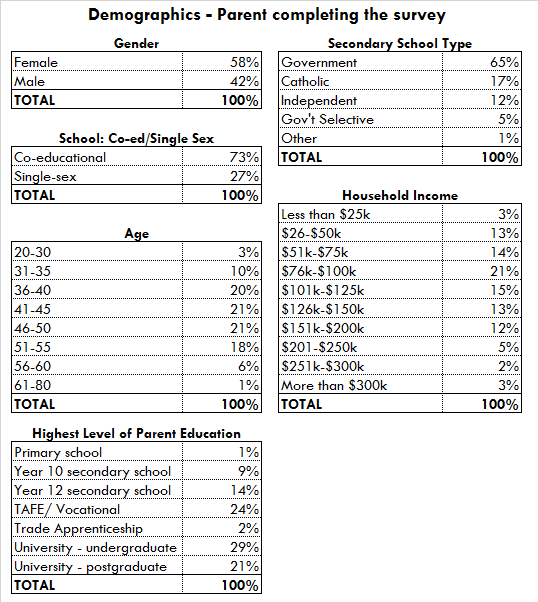
The surveys generated a representative spread of parent backgrounds, including age, education level and household income.

parent demographics2

The survey also generated a good spread of secondary school types attended by children. A situation where children in one family attend more than one school type (Mixed) is likely to occur because of 1) individual children gaining selective entry or Continue reading

‘Determinants of Parent School Choice’ Online Survey – the Results

This post will provide updated links to results as I post them. Posts will initially focus on straight forward results associated with specific questions, before proceeding onto more complex statistically analysis of relationships between questions. Continue reading